Barcelona Day 1 – Quilt Shop Tour and Other Sites


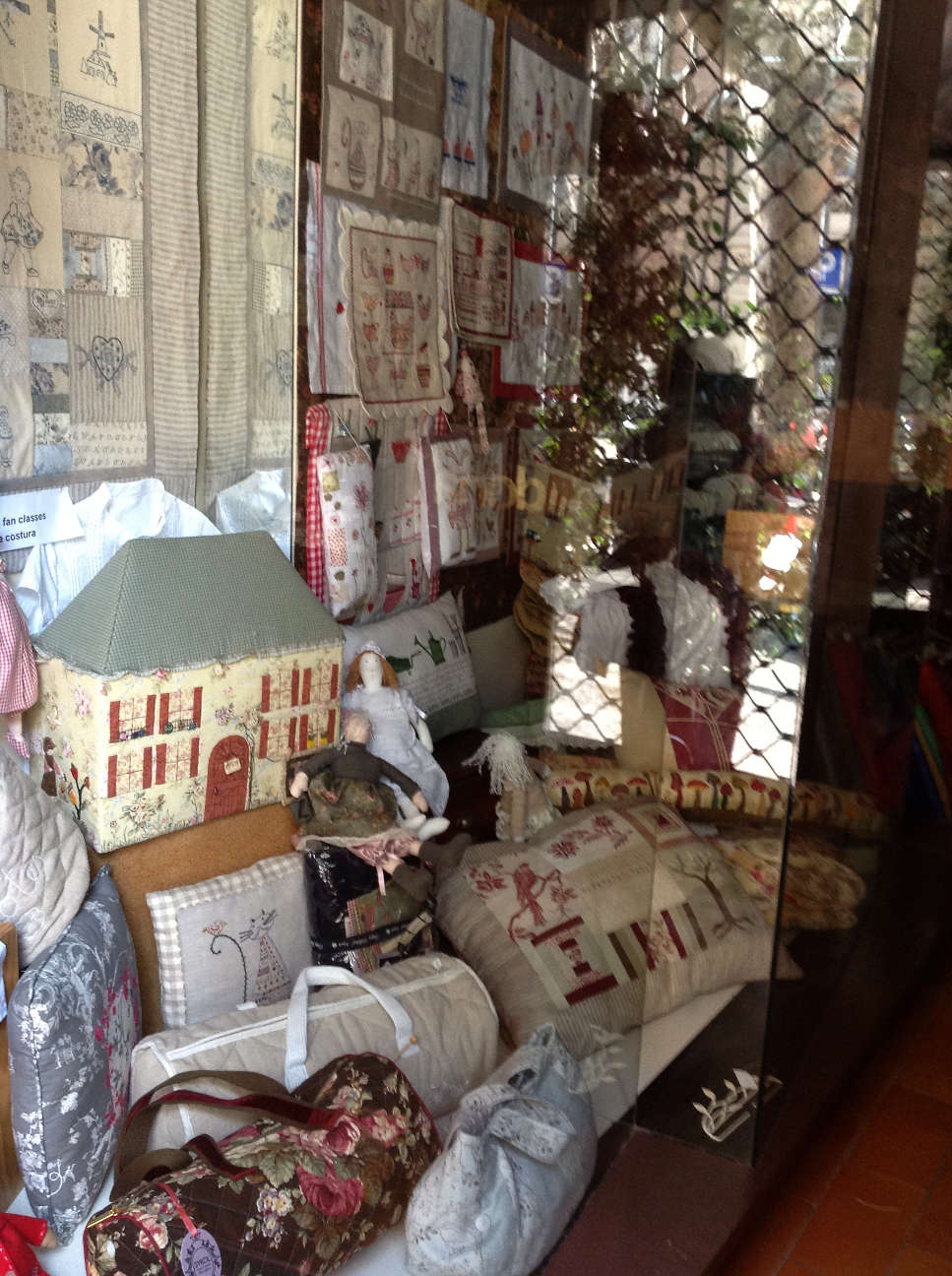
Samples in Dona Quilt Shop

I’m back from my trip to…. Barcelona!  Work was the primary reason for going, but I managed to have two whole days of sightseeing.  I walked from one end of the city to the other and had a great time looking at all the beautiful parks, buildings, churches, and quilt shops!  Yes, that’s right, Barcelona is home to at least 12 quilt shops (more if you count stores outside the city center) and my plan was to visit all of them.  This website –  www.cosman.nl – lists quilt shops in Europe and I used this to generate an itinerary.  Since I have so much to tell about my trip, I will split this into two posts – one today and one tomorrow, so be sure to check back!

Mouth-watering Gelato!

First, a brief word about the food, specifically the treats!  I am not a huge foodie, but I do love cakes, candy, and ice cream.  Barcelona does not disappoint, you can find some type of candy store, gelato parlor, or bakery on every corner!  The treats are arranged in eye catching ways and you can’t wake by too many of them without eventually being tempted to stop and indulge.
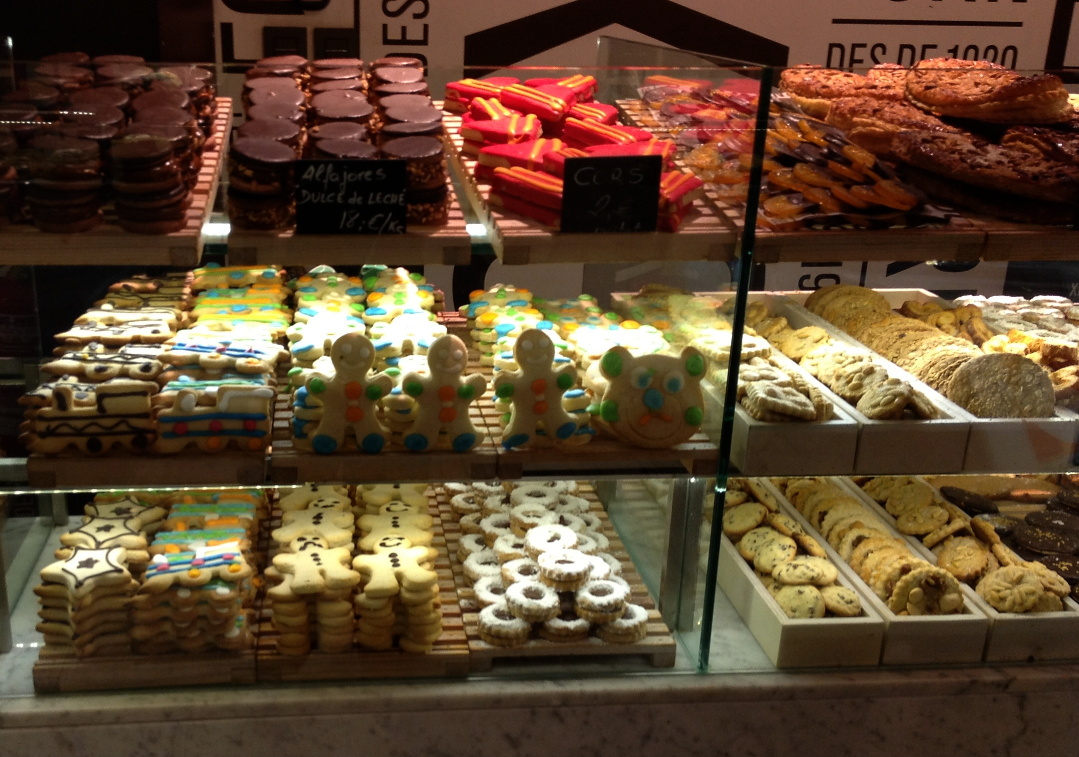
Bakery Near Hotel
Bakery Near Hotel

This bakery was next to my hotel and I stopped in each evening to pick up a little something to enjoy before going to bed.  Meringue is very popular there and it is usually dipped in chocolate or flavored with some type of fruit.

Delicious Candy!

My first chance at sightseeing was on Friday night.  I was done with my business and had an evening to my self.  I wandered around the Gothic and Las Ramblas districts since they were close to my hotel.  I stumbled upon a chamber orchestra practicing Vivaldi’s Four Season in a beautiful cathedral.  They were giving a proper concert later that night, but the rehearsal was open and it sounded as beautiful as an actual concert.

Concert rehearsal in cathedral

When I walked out of the cathedral, I found myself in the middle of festive processional.  The procession was headed by these large figurines – they are basically large puppets and someone gets inside the base and navigates the figure.  A children’s band plays music and they throw out candy to the spectators! I followed them for a few minutes and then headed back to the hotel for the night.
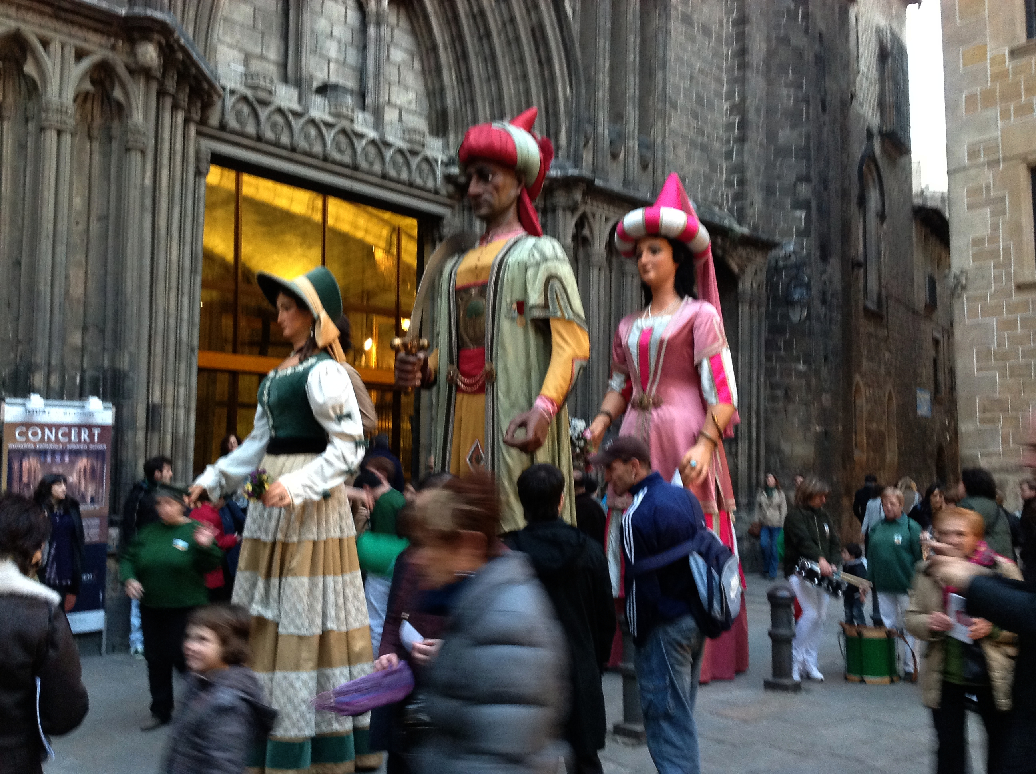
Festive Procession in Gothic Quarter

Saturday was the day earmarked for the whirlwind quiltshop tour.  Unfortunately, due to jet lag I didn’t start until about 11am, which was a problem since on Saturdays many of these shops close at 2pm!  I did manage to visit a few shops – Nunoya, Fet a Ma, and Lola Botona, but not see as many as I would have liked.

Lola Botona Quilt Shop

I am most disappointed I didn’t get to go inside Dona as this was the largest by far and the display windows (see picture above) were packed with projects and ideas.
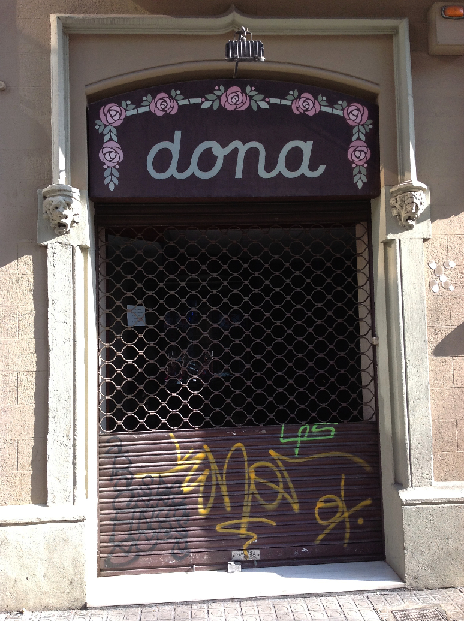
Dona Storefront

This picture on BCN Patchwork’s gate is adorable.  Too bad this is the only thing I could see!

BCN Patchwork Storefront

However, from the few shops I visited, it was obvious that things were way out of my price range.  Basically, these shops have the same fabric available in the states – Moda, Robert Kaufman, Batiks, etc. but it is $25 a yard, versus the $10 – $12 a yard!  They also have the same books — but again, these are priced at least double.  There was a very simple pincushion pattern that would sell for $5 here, but cost $20.   The shops had lots of attractive samples and I got a few ideas (you can’t take pictures in the shops so I have to rely on my memory).  So for all my friends who wanted me to get you some fabric while on my trip, I am sorry to say I came back empty handed.  However how about we hit up the local quilt shops and buy it for half price :)?

Baghangers Barcelona - House Purse

I did find one unexpected surprise, a purse shop called “Baghangers Barcelona.”  This was a small shop packed with lots of novelty purse made out of leather.  They had a pumpkin, tomato, Noah’s Ark, porcupine, and tons of other clever purses.
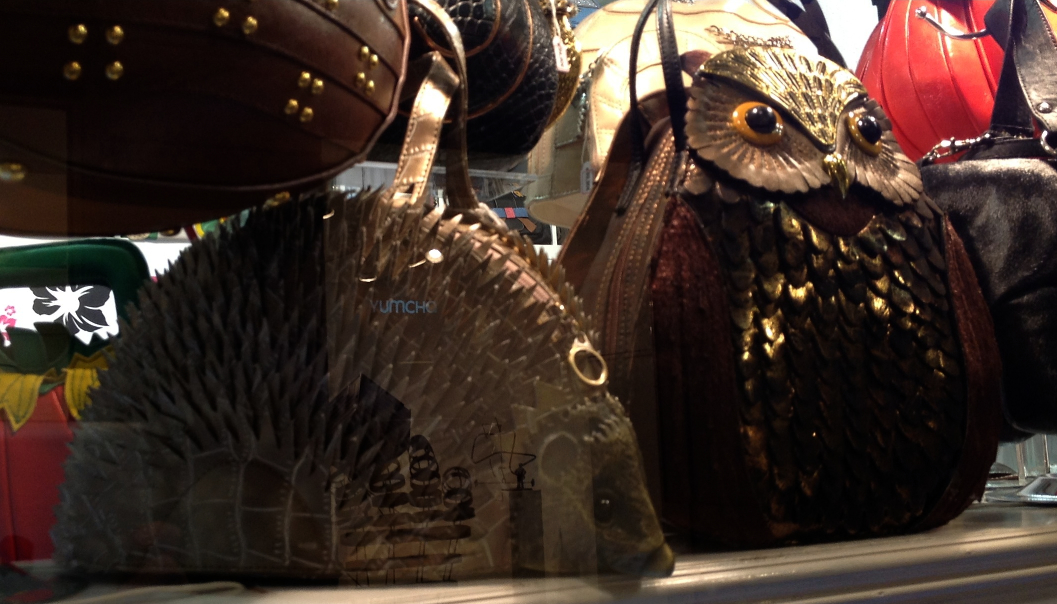
Porcupine and Owl Purses

Since I didn’t buy any fabric, I splurged and purchased a Mushroom House purse.  I couldn’t resist how cute and colorful it was!

Mushroom Purse from Baghangers Barcelona

Well, that’s the end of Day One!  Check back tomorrow for Day Two which features my trip to the Zoo!

Keep it thimble!
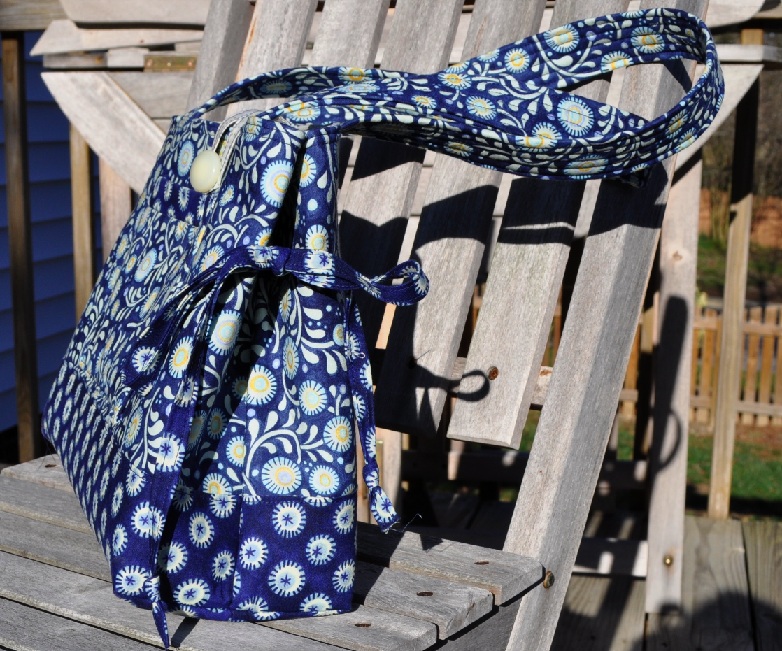
Mini Bow Tucks Tote

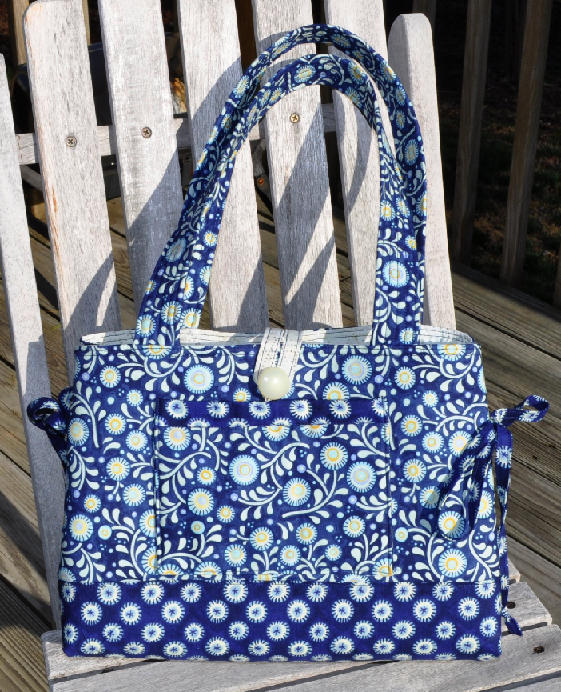
Need a new spring purse or tote?  Check out Quilts Illustrated pattern for the Mini Bow Tucks Tote.  I finished mine this week and was very happy with the results.  The pattern is well-written and easy to follow.

Mini Bow Tucks Tote
Mini Bow Tucks Tote
Mini Bow Tucks Tote - Side

Keep it Thimble!

March Flea Market Finds

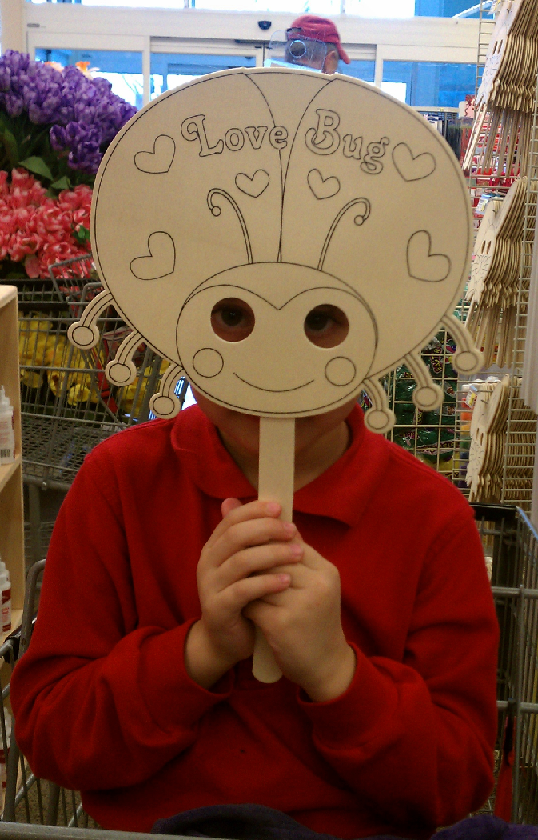
Here’s a smile for you – my son holding up this love bug mask and saying “Hello Spring”!  How can you resist?

Hello Spring!
Hello Spring!

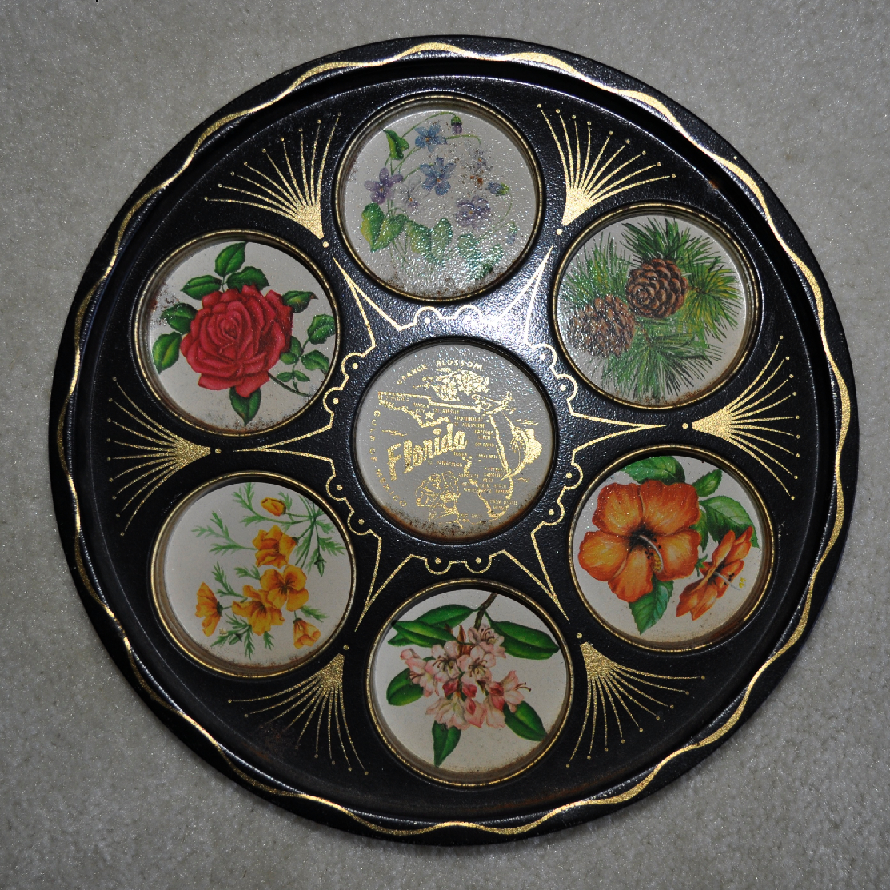
I had some good luck with flea market finds this month and found some great knick knacks.  I’m not sure what this first item is; it is some type of souvenir tray from Florida.  I think this might be for carrying drinks?  If anyone knows, please tell me!

Souvenir Tin
Souvenir Tin

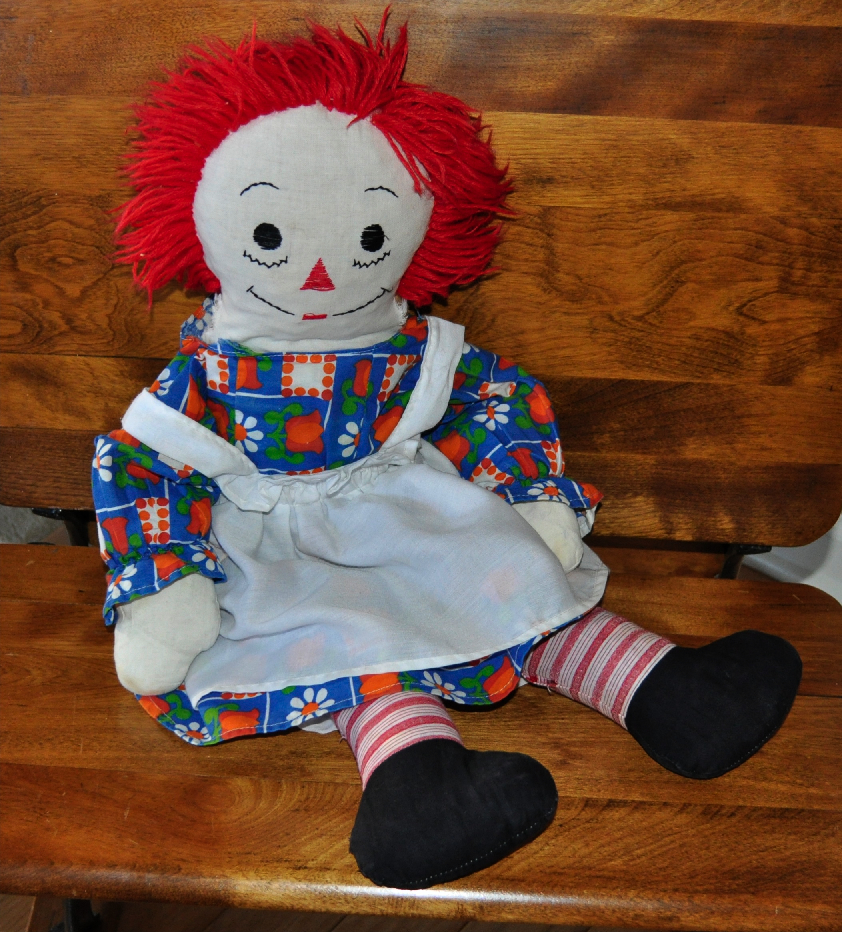
This is a handmade Raggedy Ann doll.  Her face is hand embroidered and she is stuffed with fabric scraps (very old-fashioned).  I figure she was probably made in the 60’s or 70’s based on the fabric used for her dress.  I plan to make a new dress for her from my plethora of fabric.  She looks perfect sitting on the school desk I found a few months ago.

Handmade Raggedy Ann Doll

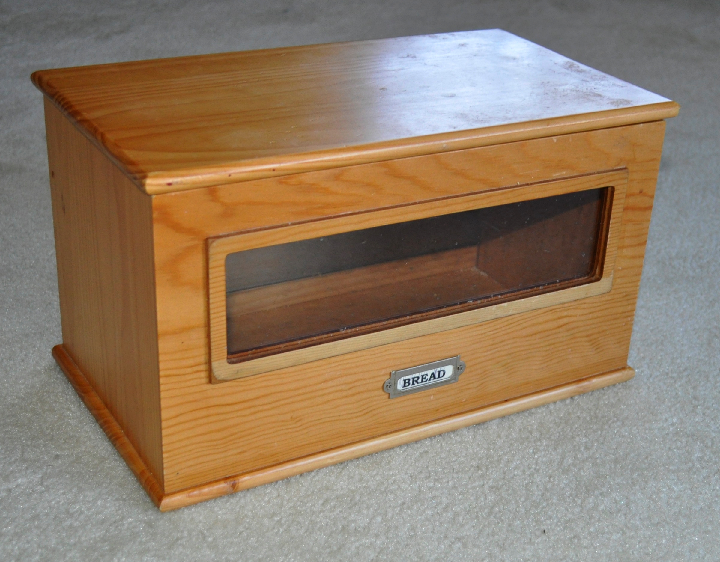
Here is a wooden bread box.  It needs a bit of cleaning (there are crumbs in it), and I may end up painting/distressing this.  It would make a perfect sewing box – especially since you can see your project through the window.

Bread Box
Bread Box

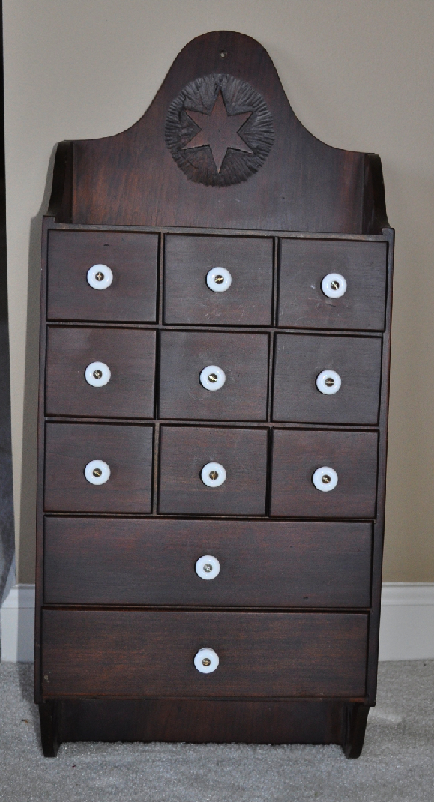
When I saw this piece with the handcarved star and the little drawers, I had to have it! According to the signature on the back, this was made in 1986, which makes it 26 years old – so it just qualifies as being vintage!

Handmade Drawers
Handmade Drawers

Lastly, here is a very clever tote bag.  This is made from a paper-pieced quilt block that shows a girl jumping rope.  Do you see how her rope is actually the handles of the bag?  Also, I love her braids!

Jump Rope Quilt Block
Jump Rope Quilt BLock

Good luck with your flea market finds!  If you find something fun, let us now by posting in the comments.

Keep it Thimble!

Tutorial – Cute Cupcake Pincushion

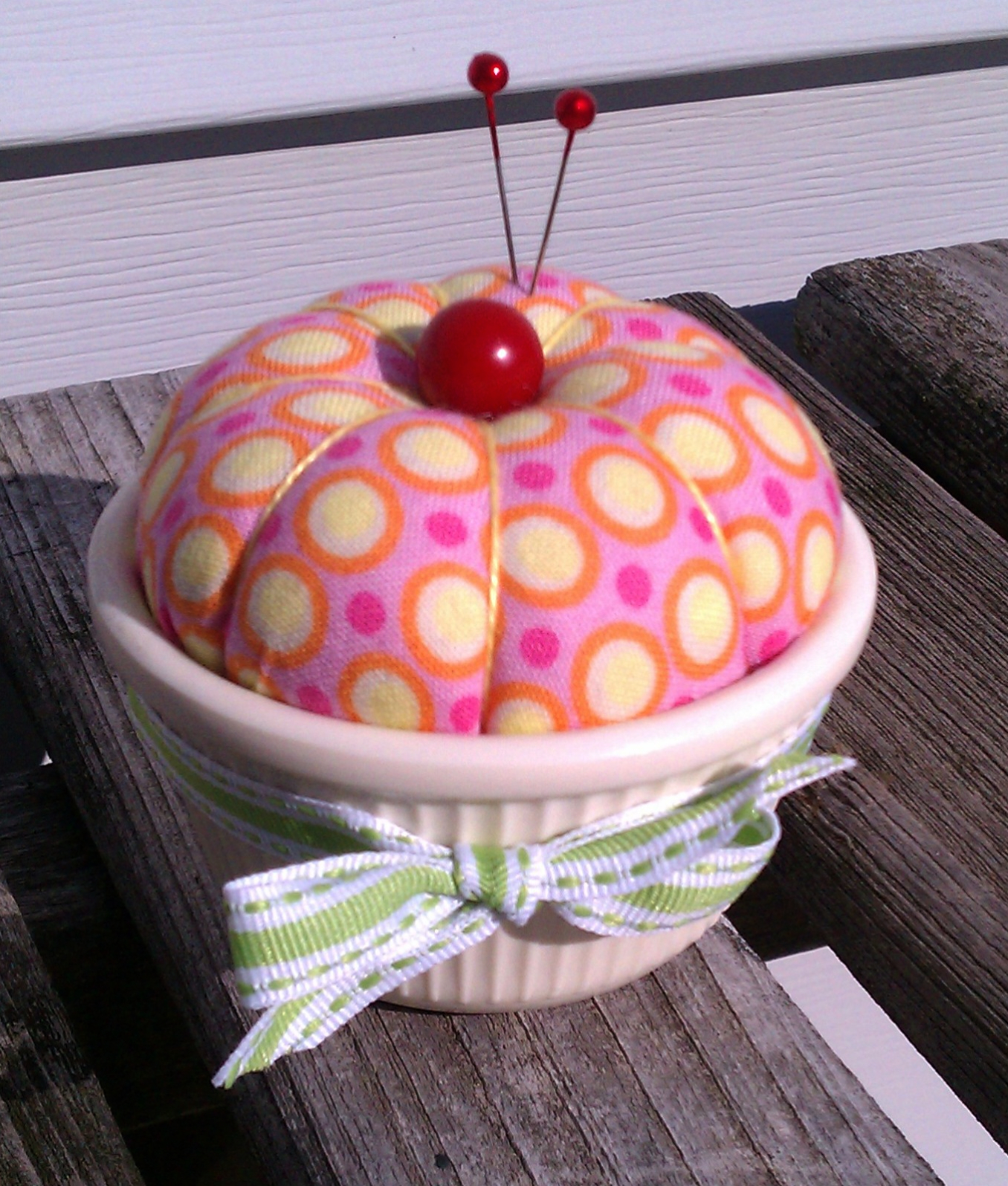
Happy Birthday to me!  Yes, today is my birthday – one of my favorite days of the year (besides Halloween and Fourth of July) and I thought it would be fun to celebrate with a Cupcake Pincushion.

Figure 6 - Finished Cupcake
Birthday Cupcake Pincushion

Awhile back during one of my thrift store runs, I bought a bunch of plastic ramekins with the idea of making something with them.  Inspiration struck me when I was trying to come up a fun gift for a sewing friend and this cute little cupcake pincushion was born.  In honor of my birthday, I put together this tutorial for you.

Supplies Needed:

  • 3 oz plastic fluted ramekin
  • Poly-fil stuffing
  • 6″ Sq. Fabric
  • Size 5 Perle Cotton
  • Red Button
  • Ribbon
  • Saucer (for template)
  • Glue (I used Allene’s Quick Dry glue)
  • Long needle
  • 3/16″ glue dots

1. Trace around the saucer on the square of fabric. The circle should be roughly 5 1/2″ in diameter.

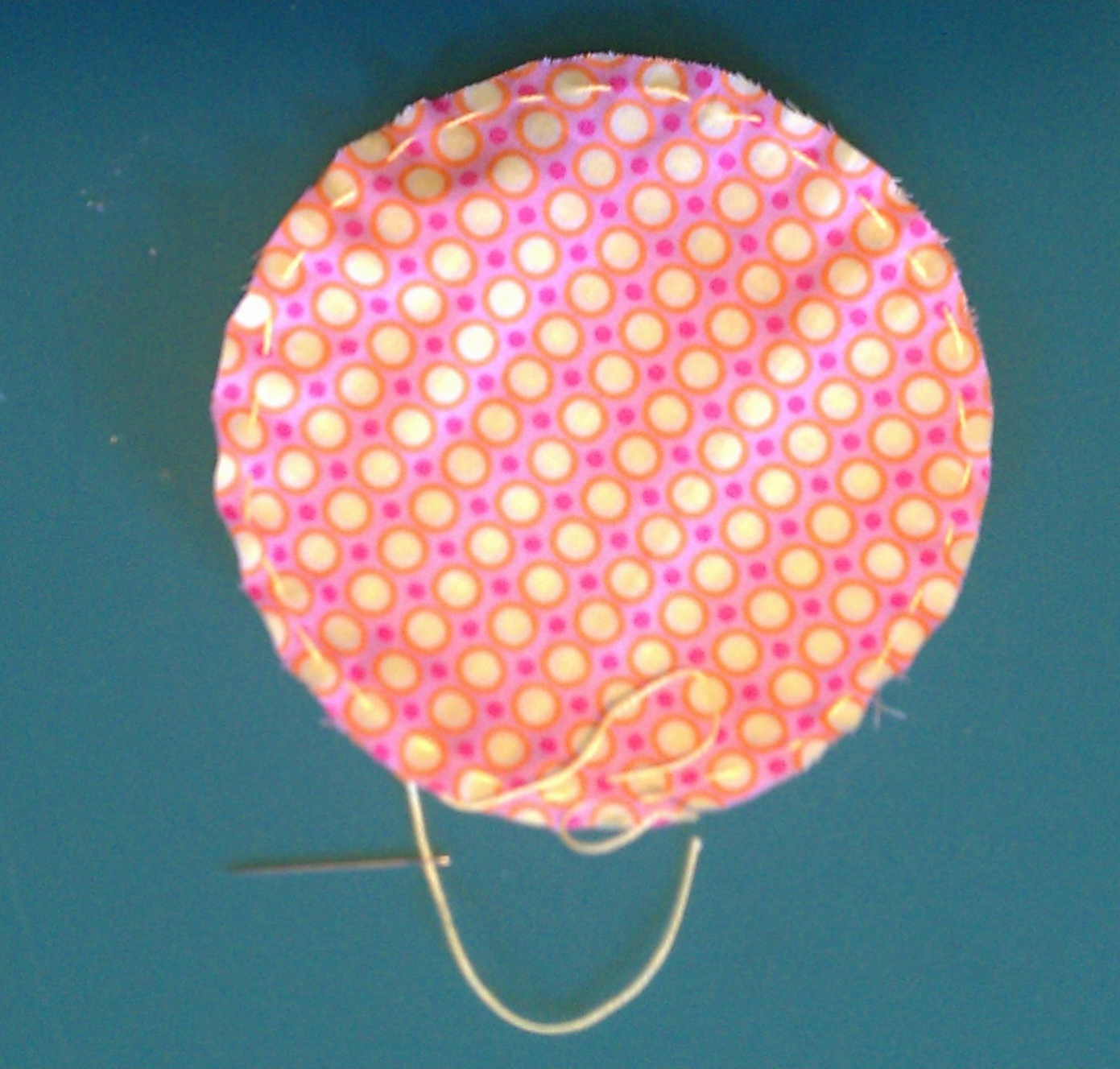
2. Thread an embroidery needle with a 36″ piece of perle cotton. Make a running stitch around the outside of the circle with about a 1/4″ seam allowance. (Figure 1)

Figure 1 - Running Stitch

3. Gather the circle and stuff tightly with Poly-fil. Gather tightly and tie off, but leave about 28″ of thread for the long tail – do not cut. (Figure 2)

Figure 2 - Stuff
Figure 2 - Stuff

4. Poke the needle through the top center of the pincushion and come out at the bottom center. Wrap perle cotton around edge of pincushion and come down through the top center again. Pull on thread to make tight (cushion will dimple on the side). Wrap cotton on the opposite side and come down through top center again and pull tight. Proceed in this manner until you have done this a total of 8 times. The cushion will now be segmented into 8 parts. (Figure 3)

Figure 3 - Segment Cushion

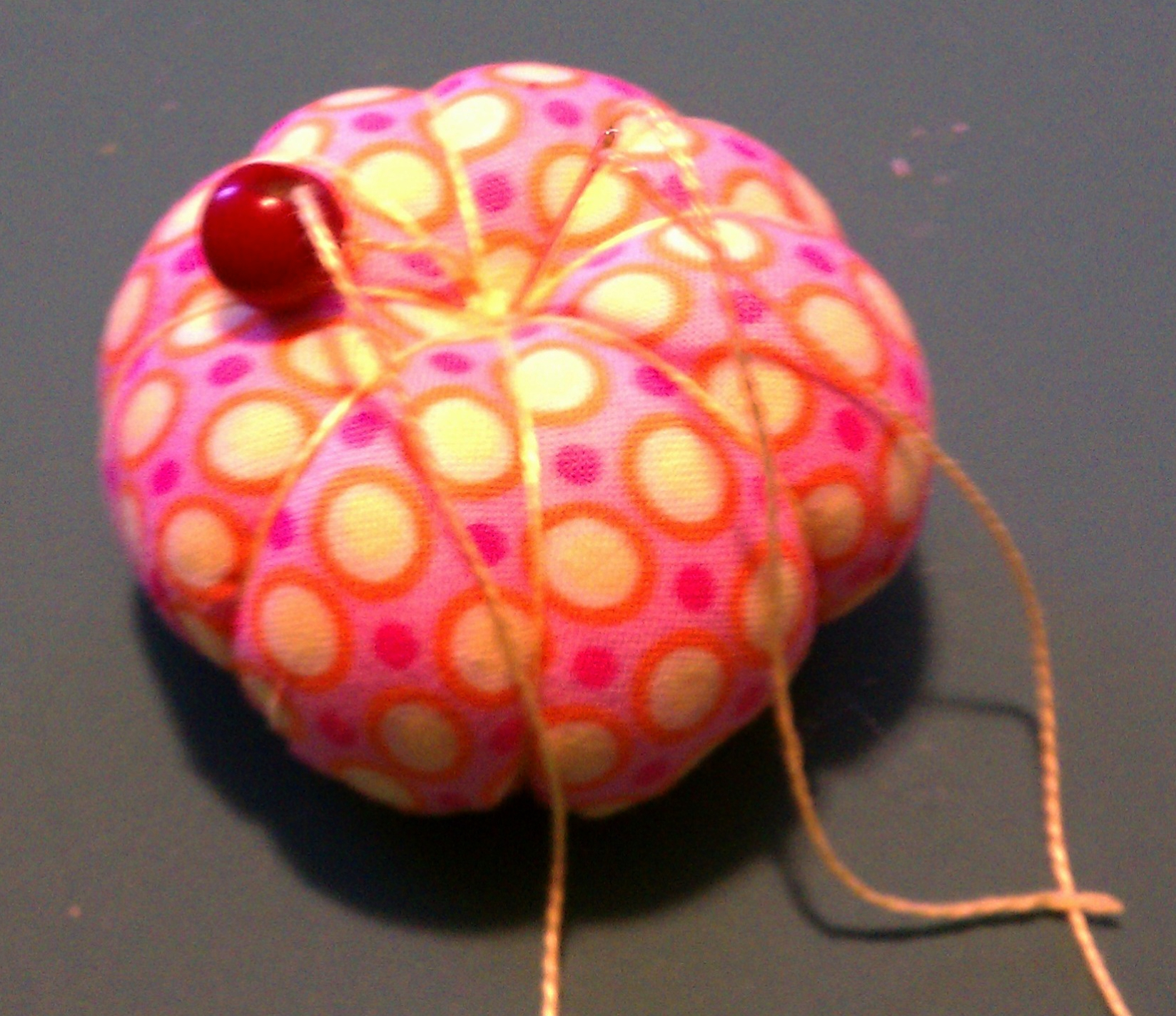
5. Bring thread up through center one more time so that it is coming out through the top center. Take red button and place in top center of pincushion. Thread the perle cotton through button holes and then down through bottom to secure button. Repeat 2 – 3 times. (Figure 4)

Figure 4 - Sew button

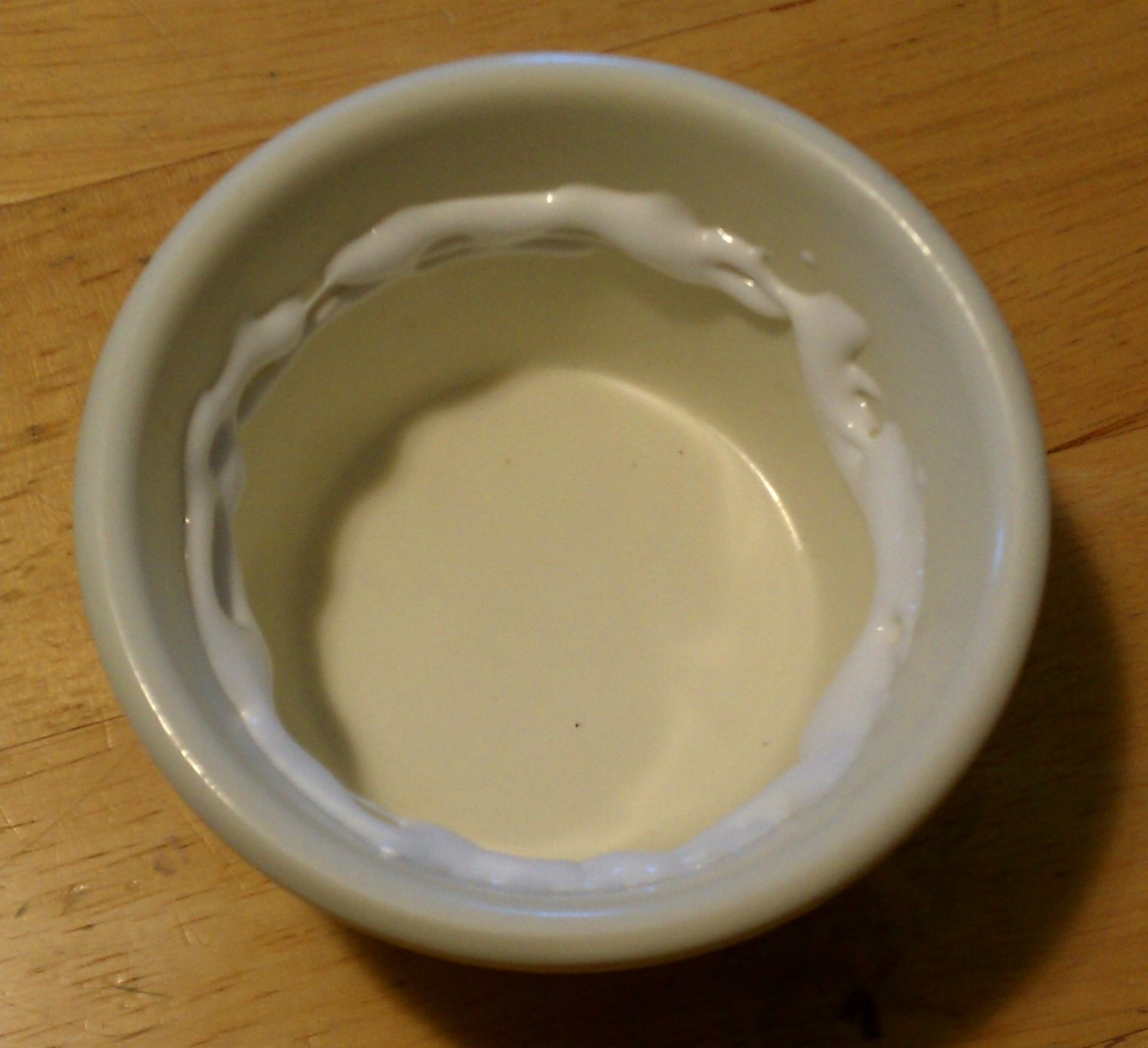
6. Apply glue to inside of ramekin. (Figure 5). Place cushion inside ramekin and let dry for a few hours.

Figure 5 - Glue in ramekin

7. Cut 18″ of ribbon. Use glue dots to secure ribbon to outside of ramekin (place glue dots about every inch around top). Tie into a bow. Put a dot of glue to secure bow. Add some pins. Enjoy! (Figure 6).

Figure 6 - Finished Cupcake

Have a great day and eat some real cake.

Keep it thimble!
 

Two Pillows – Finally Finished!

First off, here’s my monthly stash reduction report for February 2012:

  • Used the last month: 4 yards
  • Used Year to Date: 5 yards
  • Added in the last Month: 2 yards
  • Added Year to Date: 32 yards
  • Net Used for 2012: +28 yards

As you can see, I had a much better month then January, since I actually used more fabric than I bought.    My overall net went down by 1 yard, so surely by the end of the year my net fabric used will be running in the negative (that’s the goal).

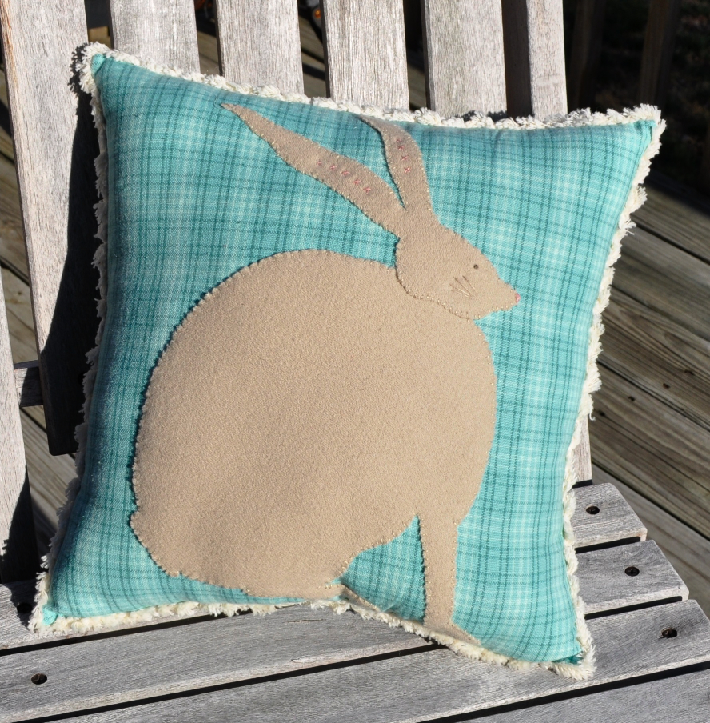
Wool Rabbit Throw Pillow

I also had time to finally finish two pillow kits that I’ve had for at least 4 years!   The first is a cute little wool bunny – perfect for Spring. This kit is from a LQS (local quilt shop), and I think the owner of the shop drew the bunny pattern.  This is wool applique on top of one of those colorful cotton dishtowels.  The trim is a cream colored fringe that sets off the pillow perfectly.

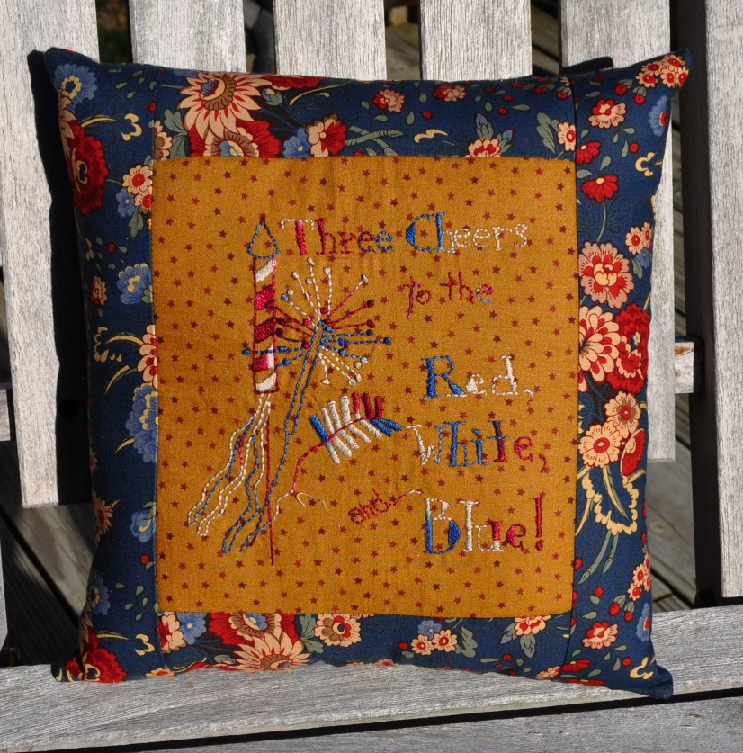
Fourth of July Pillow

The second pillow is from a Crabapple Hill pattern (I think it was a freebie pattern she offered a long time ago).  It is stitched with Red, White, and Blue perle cotton.  I love the fireworks!

What projects have you been able to complete this month?  What are you working on for Spring?

Keep it Thimble!

5 Must-Have Sewing Notions

Shaker Pincushion

Sewing gadgets can make life easier, and if they are the right price, I am happy to try them out. Some of these things include a bobbin winder (used twice), a 1/4″ rule for marking seams (used a lot!), and the Dritz EZ Hem (used once for this dress). As you can see, even when you have the right tool for the job, you may not find that it is a must-have (just a fun to have). However, there are 5 sewing tools I can’t live without.

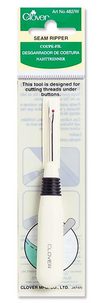
1. Seam Ripper

Clover Seam Ripper

This gets used all the time! I used to get frustrated whenever I had to rip out a seam, but now I find it kind of therapeutic. Seam ripping is a nice break during a marathon sewing session. Also, once I learned the correct way to rip out a seam, the job was much faster and easier. There are two seam rippers I recommend (having used both quite a bit): the ergonomic once by Clover and the Dritz one that folds (which is nice for travel). The main thing is to pick a seam ripper you can easily hold in your hand without it cramping up.

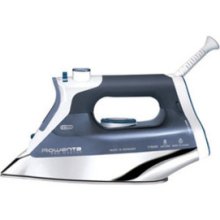
2. Iron

Rowenta Steam Iron

An iron is on this list, even though it is probably not considered a sewing notion, but it is a necessity. There are wide variety of opinions on which one is best. Many people swear by their $20 iron, while others say that the more expensive irons are worth the money. I’ve had experience with both types and I find the more expensive irons (like a Rowenta) really do work better for quilting and sewing. This is because of several reasons — and if you can find a cheaper iron that has the following features, get it:

The first thing to consider is the weight of the iron, a big heavy iron is going to work better since the natural weight of the iron makes it easier for you to press down and get a nice flat seam. Some people find that an iron can be too heavy and thus tire out their arms, so keep this in mind. The temperature is another factor in how well your iron works – you want a iron that can get nice and hot, especially when working with cotton – the hotter the iron, the flatter the seam. The final thing to consider is steam – more expensive irons have more holes for the steam to escape, which makes better use of the steam. One caveat is that if you store your iron with water inside, it is more likely to leak. I have heard that keeping water in the iron is the biggest reason why irons start leaking and break down. Each time I finish with my iron, I empty out the water, and I also run the self cleaning function a few times a month.

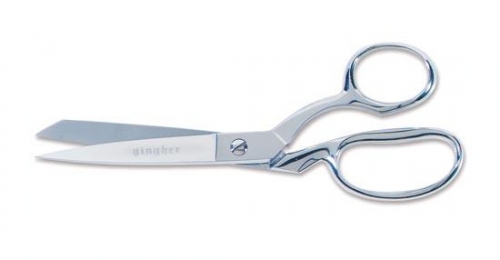
3. Scissors

Gingher 8" Dressmakers Shears

Again, this is an area where you can spend a little or lot of money. After comparing scissors, I splurged and bought Ginghers (made in the USA!) –8″ dressmakers shears for cutting fabric, 7″ craft scissors for ribbon, wool, and foundation piecing, and a 4″ utility pair for embroidery and applique (also good for travel). There are several reasons that Ginghers are worth the money. First, they accurately cut all the way to the very tip of the blade. This is especially important for detail cutting, where you don’t want to risk a slip of the scissors. They are really sharp and can through cut several layers of fabric at once. They are LIFETIME scissors, meaning they will never wear out and I can send them to Gingher at anytime to get them sharpened (for a nominal fee) and they will be like new again.

One interesting thing to note is the difference between scissors and shears. The word “scissors” is used interchangeably between the two, but there is a difference Scissors are usually smaller, and feature two similar sized round holes for your fingers. The handles are separate and made of plastic while the blade part is metal.

Shears feature a round hole for the thumb and a larger oval hole for the rest of your fingers. This makes the shears easier to control when you are cutting fabric. The handle and blade are made out of one piece of metal. , which means that shears are two metal “scissors” held together by a bolt.

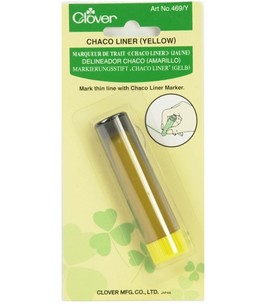
4. Chalk Wheel Marker

Clover Chalk Wheel Marker

Oftentimes while sewing, there is a need to mark the fabric. For example, you may need to draw lines for quilting, divided pockets, o r a hemline. The chalk wheel marker makes a nice sharp line and wipes off very easily. For a few dollars you can purchase a bag of chalk dust for refills and it last a loooong time.

5. Pincushion

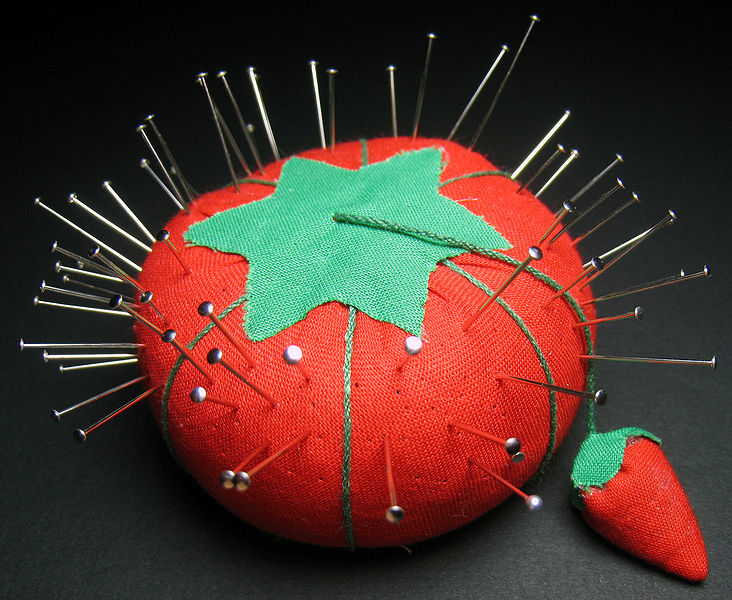
Tomato Pin Cushion

Pincushions are something I can’t live without. They are pretty, functional, and fun to make. I have three that get used on a regular basis, and several others for decorative purposes. They are great scrap busters and you can make them in variety of shapes and sizes.

From a functional standpoint, pincushions are much easier to use — you don’t have to worry your pins falling on the ground as you add and remove pins to your project. If you want to get fancy with your pins and needles organization you can section off the pincushion by type – needles in one section, applique pins in another, and quilting pins in a third.

Finally, the tomato pincushion is pretty much the universal sewing symbol. Why the tomato you ask? According to some, people used to place a ripe tomato on the mantle of a new home to guarantee future prosperity. However, in those days, tomatoes were not available year-round (or would rot easily), so a round ball stuffed with sawdust or sand was used instead. These balls were the perfect place for storing pins, thus the tomato pincushion was born. The strawberry that is attached to most pincushions is filled with emery which is useful for sharpening pins. I wasn’t able to find an explanation for how the strawberry got added to the pincushion…if anyone knows, please enlighten us!

Shaker Pincushion

Since everyone needs a pincushion and a place to store all their odds and ends – a Shaker Pincushion is the perfect solution. Click here for my free pattern. Enjoy!

Keep it Thimble!

Tutorial – Pretty Patchwork Heart Pocket

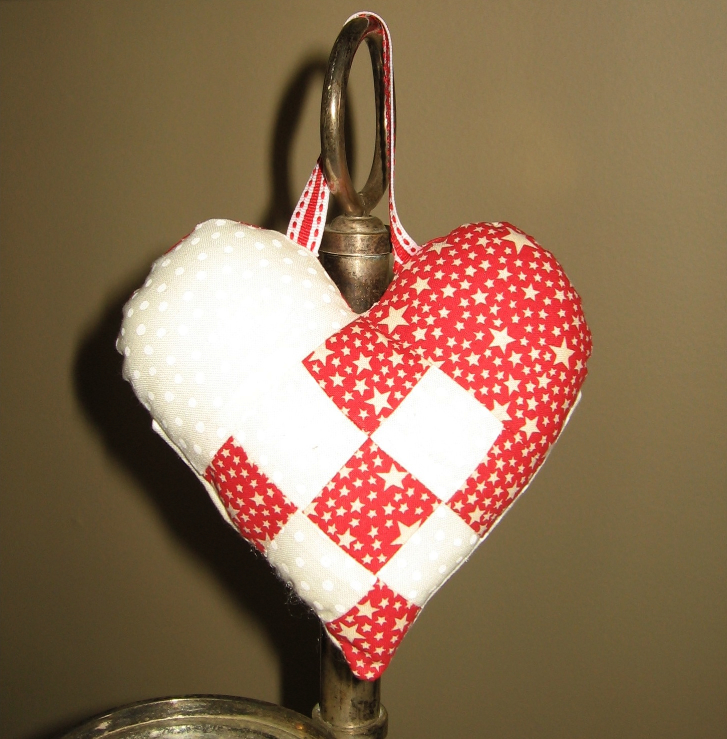
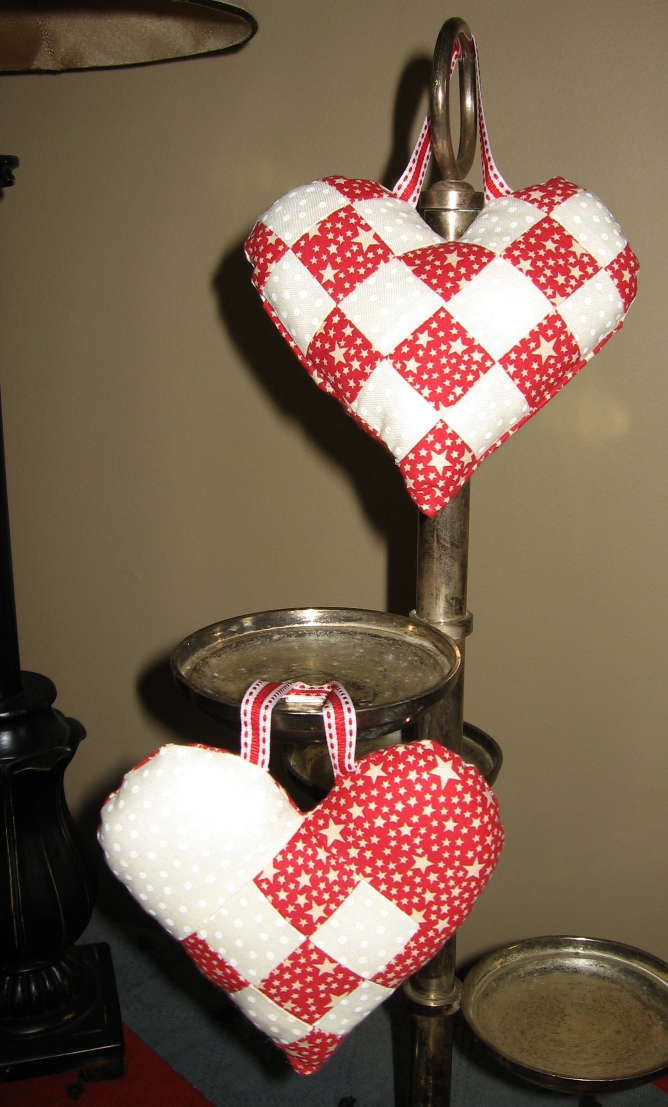
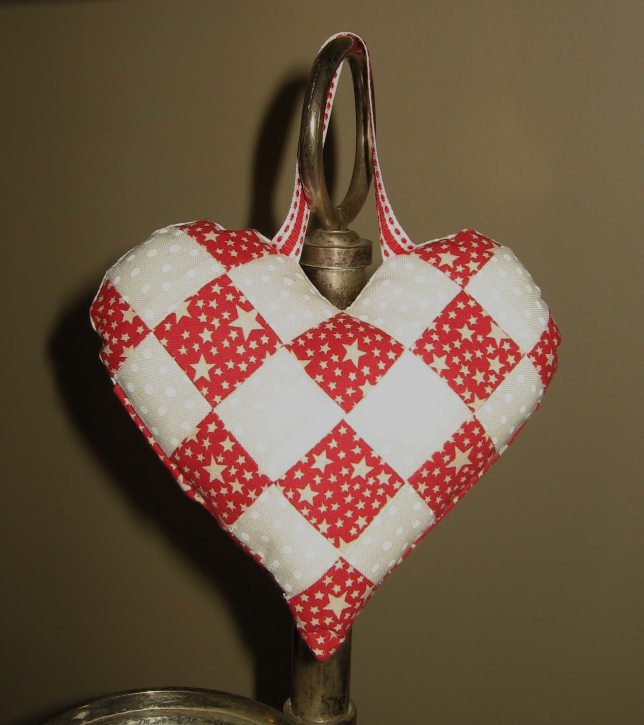
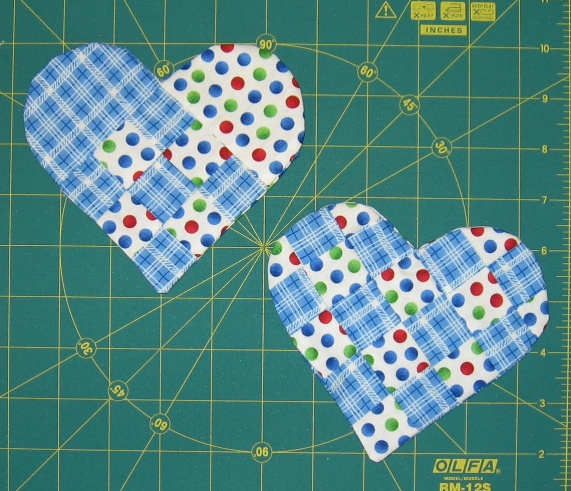
Looking for a quick gift or a fun home dec idea?  Here’s a set of Pretty Patchwork Heart Pockets that can be sewn together in about an hour.  This tutorial includes directions for making both versions!

Pretty Patchwork Heart Pockets

Make a bunch of these and place in a pretty basket or bowl.  Use clothespins to attach them to ribbon and create a fun garland or window swag!

Pretty Patchwork Heart Pocket - Version 1

You can use scraps for this and make them in a variety of colors – red and white for Valentine’s Day, green and white for St. Patrick’s Day, red/white/blue for Fourth of July, orange and black for Halloween, or red and green for Christmas!

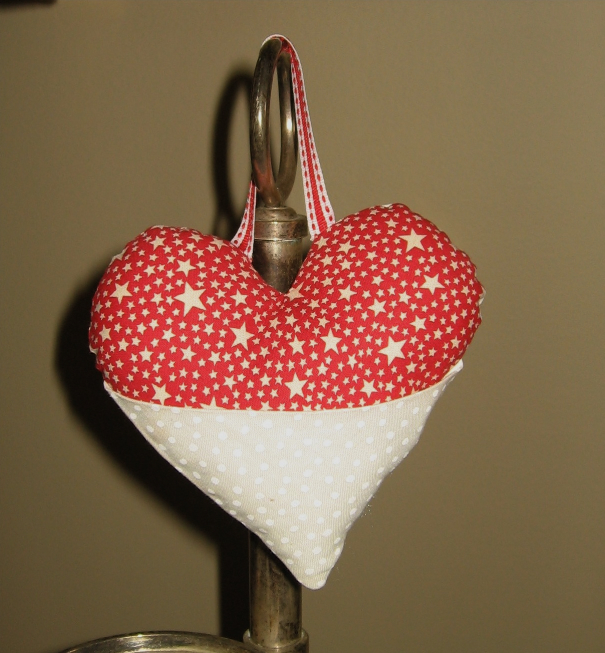
Pretty Patchwork Heart Pocket - Version 2

The back features a small pocket.  Tuck in a gift card or some dried flowers.

Pretty Patchwork Heart Pocket - Back View

From Fabric A cut:

  • Three 4.5″ squares
  • One 5.5″ Square
  • One 3.5″ x 2.5″ rectangle

From Fabric B cut:

  • Three 4.5″ squares
  • One 5.5″ Square
  • One 3.5″ x 2.5″ rectangle
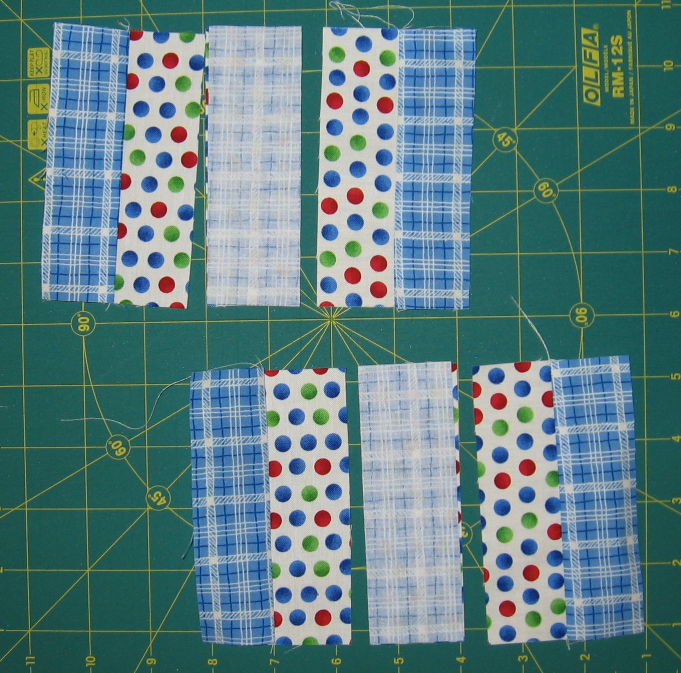
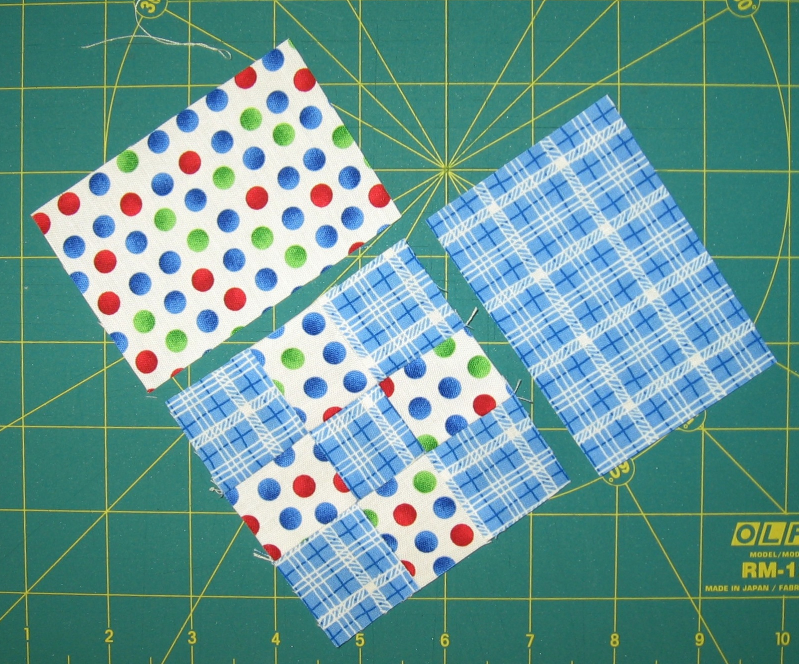
Take one Fabric A 4.5″ square and one Fabric B 4.5″ square.  Pin the squares right sides together and sew a 1/4″ seam on the right and left sides.  Make two sets (Figure 1).
Figure 1 - Sew Side Seams

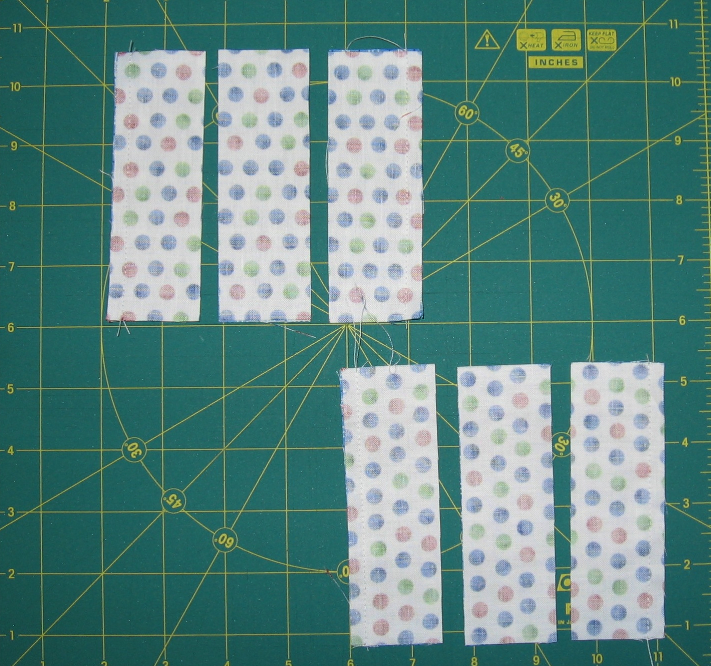
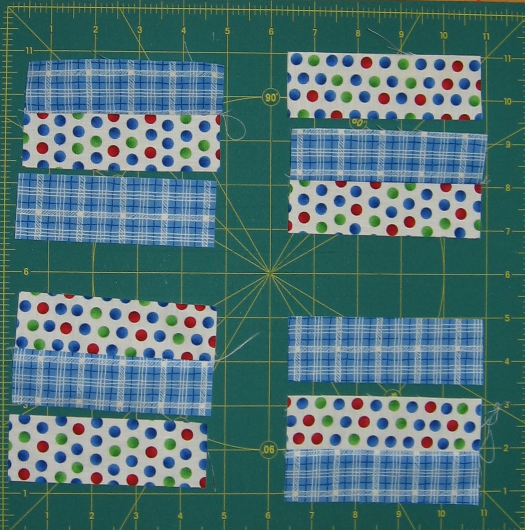
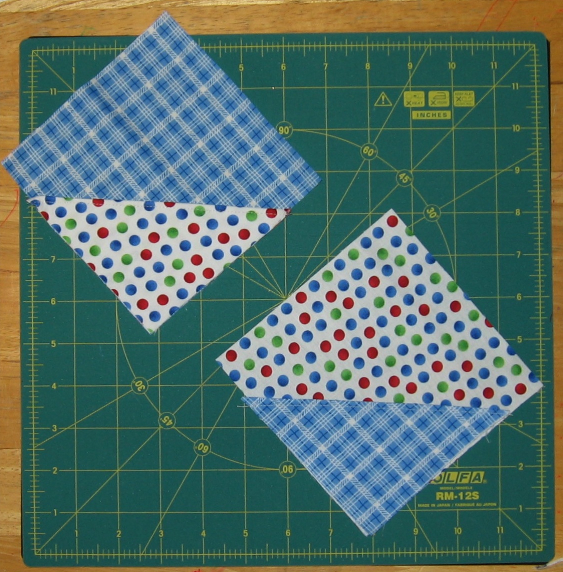
Cut these units into three rectangles that are 1.5″ x 4.5″.  Make sure you are cutting parallel to the seams you just made (Figure 2).  Do this for both sets.

Figure 2 - Cut Into Strips

Press the seams towards the darkest fabric to create two pieced units (Figure 3).

Figure 3 - Press open

Take the center rectangles and sew them to the appropriate side of the pieced units (Figure 4).  Press the seams to the darks.  You now have two units of alternating fabrics (A-B-A and B-A-B). Make two sets.

Figure 4 - Sew Strips to Create Squares

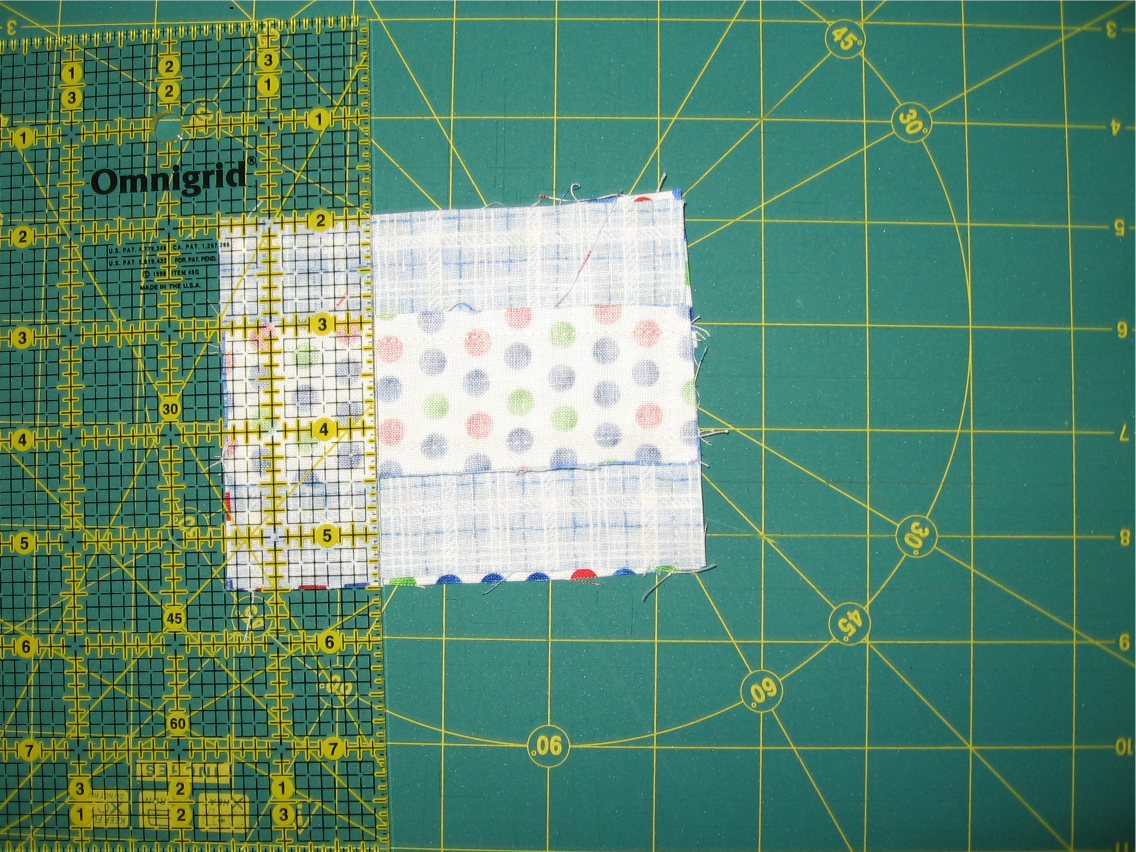
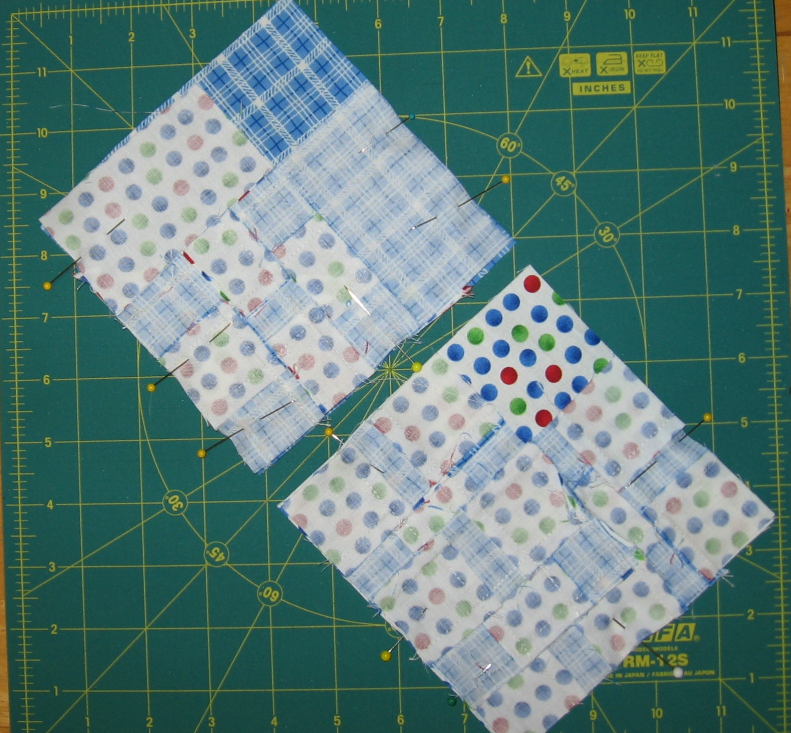
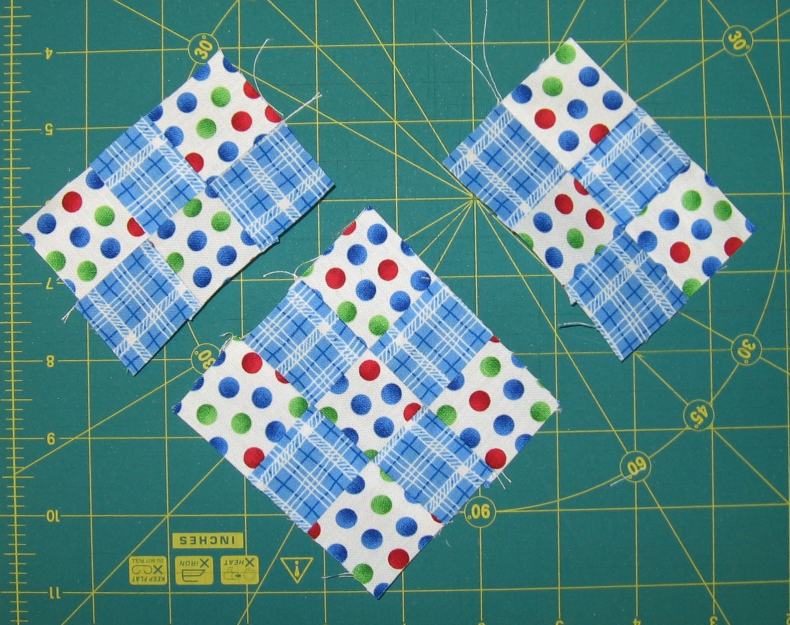
Take one of each type of square  (A-B-A and B-A-B), make sure stripes are going the same direction, and pin them right sides together.  Sew along the shorter sides with a 1/4″ seam.  Do this for both sets.  Cut each set into three rectangles that are 1.5″ x 4.5″.    You will be cutting perpendicularly to the stripes (Figure 5).  Press the seams.

Figure 5 - Sew Side Seams and Cut Into Strips

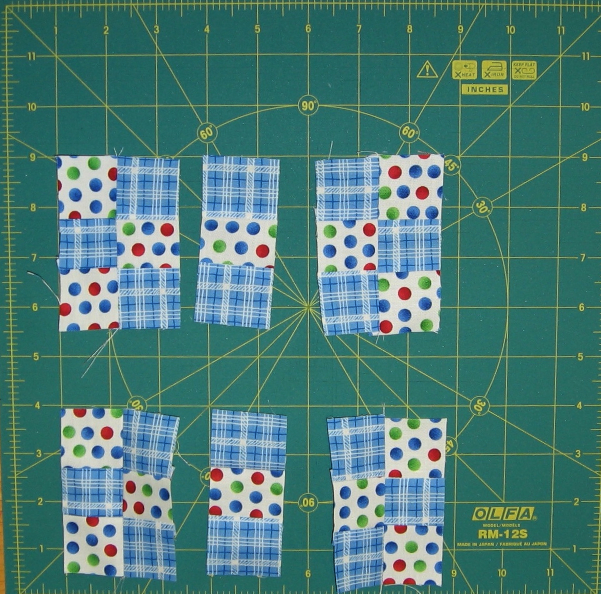
Sew the center strip to the appropriate pieced unit to make TWO nine-patch blocks (Figure 6).  Do not sew the other strips to make blocks.  You will now two nine-patch blocks and two sets of partial blocks.

Figure 6 - Sew Two Nine Patch Blocks

To make Version 1, sew the partial blocks onto one nine patch block (Figure 7).

Figure 7 - Create Version 1 Heart

Take make Version 2, sew the 3.5″ x 2.5″ rectangles onto one nine patch block (Figure 8).

Figure 8 - Create Heart Version 2

Set these two heart fronts aside and make the pocket.  Take the remaining two of the 4.5″ squares, and press it on the diagonal right sides OUT (Figure 9).

Figure 9 - Make Pocket

Take one of the 5.5″ squares, place it right side up, and then pin one of the folded triangles on this to make the pocket.  For best results, use contrasting pocket  on the backing fabric (Figure 10).

Figure 10 - Pin Backing to Pocket

Pin one heart front and one heart back right sides together (Figure 11).

Figure 11 - Pin Backing and Heart Right Sides Together

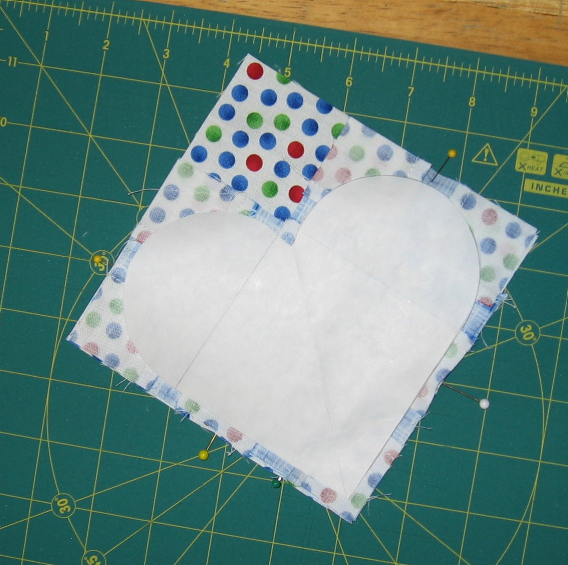
Download Heart Template here.  Trace onto piece of cardboard and cut out template.  In order to create sewing line, place template on pinned hearts and trace around it (Figure 12).  DO NOT CUT.  Sew around the line you just drew – leave a 3″ opening in one side for stuffing.

Figure 12 - Trace Around Heart Template

Cut off excess fabric and leave about 1/4″ seam.  Clip corner, curves, and heart center.  Turn inside out (Figure 13).  Stuff lightly and hand-stitch opening closed.

Figure 13 - Turn Inside Out and Press

Keep it thimble!
Sewing Bowl Sunday!

This Sunday, instead of watching the Pats and Giants in the Super Bowl – why don’t you plan on having a Sewing Bowl?  You can still have all the great snacks and watch the new commercials on Hulu!  This is a great excuse to get your sewing buddies together and get caught up on some of your unfinished projects.

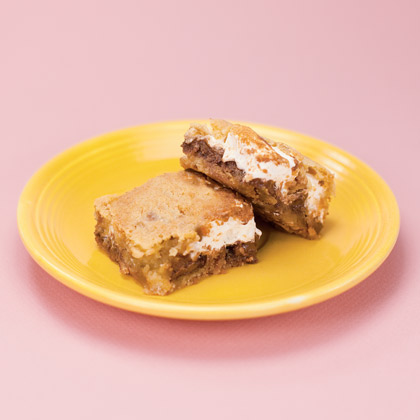
Here’s a recipe for some delicious Smores bars that will be great for whatever you plan to do on Sunday. They are easy to make and easy to eat!  Just don’t get crumbs on your fabric.

Smore’s Bars – Family Fun Magazine
  • 1/2 cup sugar
  • 1/2 cup butter, softened
  • 1 large egg
  • 1 teaspoon vanilla extract
  • 3/4 cup crushed graham crackers
  • 3/4 cup all-purpose flour
  • 1/4 teaspoon salt
  • 1 teaspoon baking powder
  • 3 (1.55-ounce) chocolate bars
  • 1 (7-ounce) jar of marshmallow creme

Instructions

  1. Grease an 8-inch-square baking pan. Heat the oven to 350 degrees.
  2. In a large mixing bowl, cream the butter and sugar until fluffy. Beat in the egg and vanilla extract. Add the crushed graham crackers, flour, salt, and baking powder and beat until well mixed, stopping occasionally to scrape the sides of the bowl.
  3. Spoon half the dough into the pan and spread evenly with your fingertips. Break the chocolate into pieces and arrange over the dough. Spread a layer of marshmallow creme over the chocolate. Flatten the remaining dough into pancakes and lay them over the marshmallow.
  4. Bake until golden brown, about 30 minutes. Let the bars cool before serving. Makes 16 bars.
    Nutritional Information
    Per serving (1 bar): Calories 200 ● Total Fat 9 g ● Saturated Fat 5 g ● Cholesterol 30 mg ● Sodium 145 mg ● Total Carbohydrate 28 g ● Fiber .5 g ● Sugars 17 g ● Protein 2 g
    Originally published in Family Fun magazine.

True Fabric Confessions

I have to confess, I’ve already blown my stash reduction resolution made at the beginning of the month – it’s a lot harder than I thought!  In my defense, I had good reasons for purchasing the following items (and some of it falls under the rule exceptions).

Adding to my Halloween stash

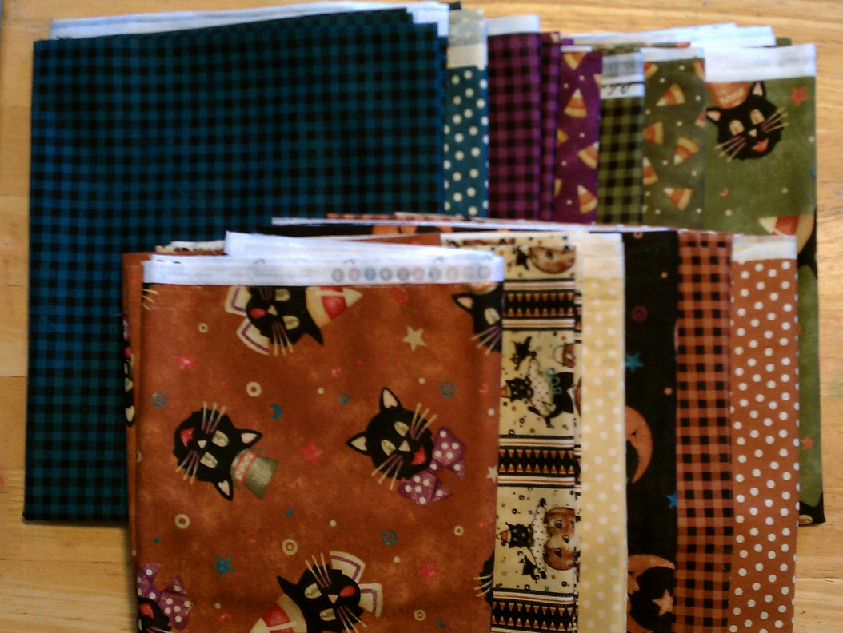
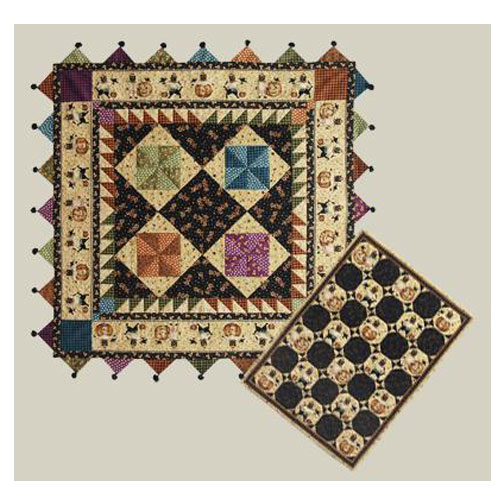
Here is a bundle of Halloween fabric I purchased at an online quilt shop.  This fabric line features “Boo Kitty” and is designed by Bonnie Sullivan of All Through the Night.  There are several good reasons why I needed this much.  First, it was on sale for a very good price and there was a 1 yard minimum cut per fabric.  Second, this line was released years ago and is VERY hard to find.  Third, I have the cutest pattern for a Halloween table topper that uses this fabric and I WILL make it – I promise!

Halloween Celebration by Bonnie Sullivan, All Through the Night

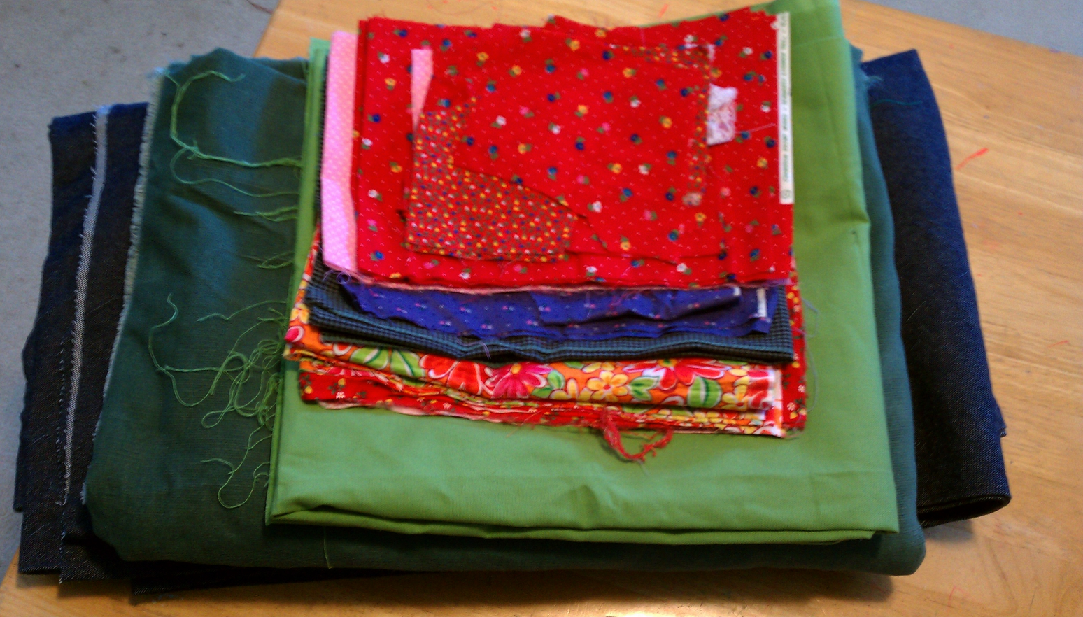
Here is my haul from the thrift store.  I usually find nice large pieces of corduroy and denim that I can use for my bags.  There is a new pattern in the works and I will need to make a few prototypes.  It’s better to use fabric from the thrift store since it is so cheap (about $1 a yard).

Thrift Store Stash

So, as you can see, all these purchases were justifiable.  But just to keep things honest, I am going to write down my MONTHLY stash report (it’s apparent these need to be done monthly, in order to have the desired effect of actually reducing the stash):

  • Used the last month: 1 yard
  • Used Year to Date: 1 yard
  • Added in the last Month: 30 yards
  • Added Year to Date: 30 yards
  • Net Used for 2012: 29 yards
Keep it Thimble!
January Flea Market Finds!

Back by popular demand – Flea Market Finds!  At the end of each month I will post some of my better “finds.”  Some months I do really well, other months I don’t have much luck!

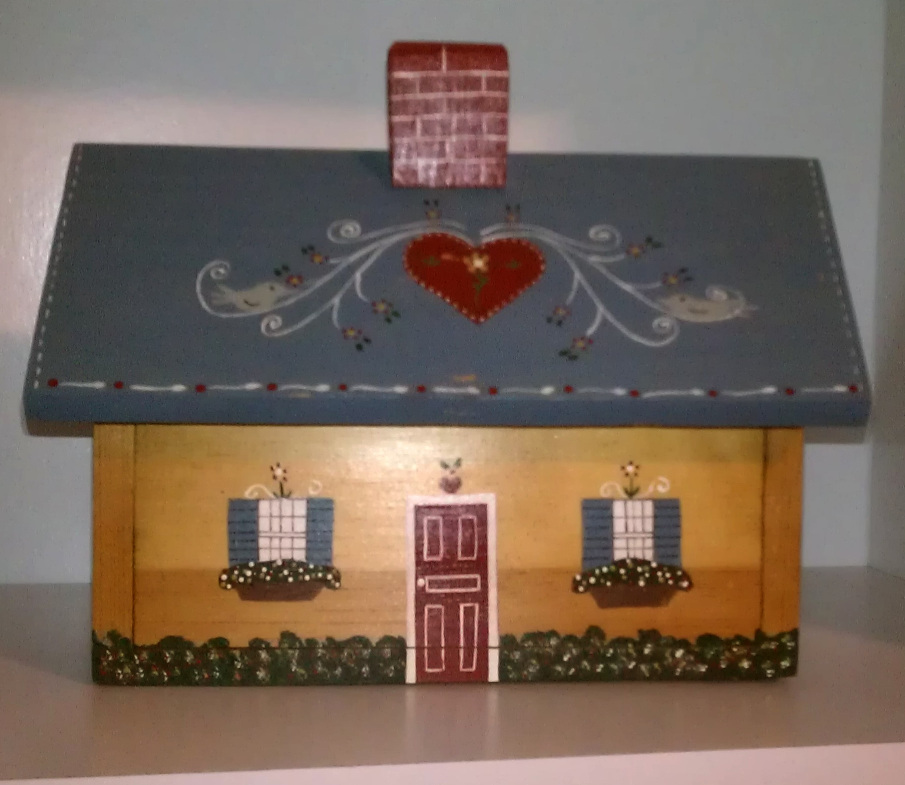
This is a cute little house box I found at the local thrift store.  It is handpainted and the colors work great with the vintage red,white, and blue color scheme I have in my sewing room.  The roof lifts off and you can store treasures  inside.

Little House Box

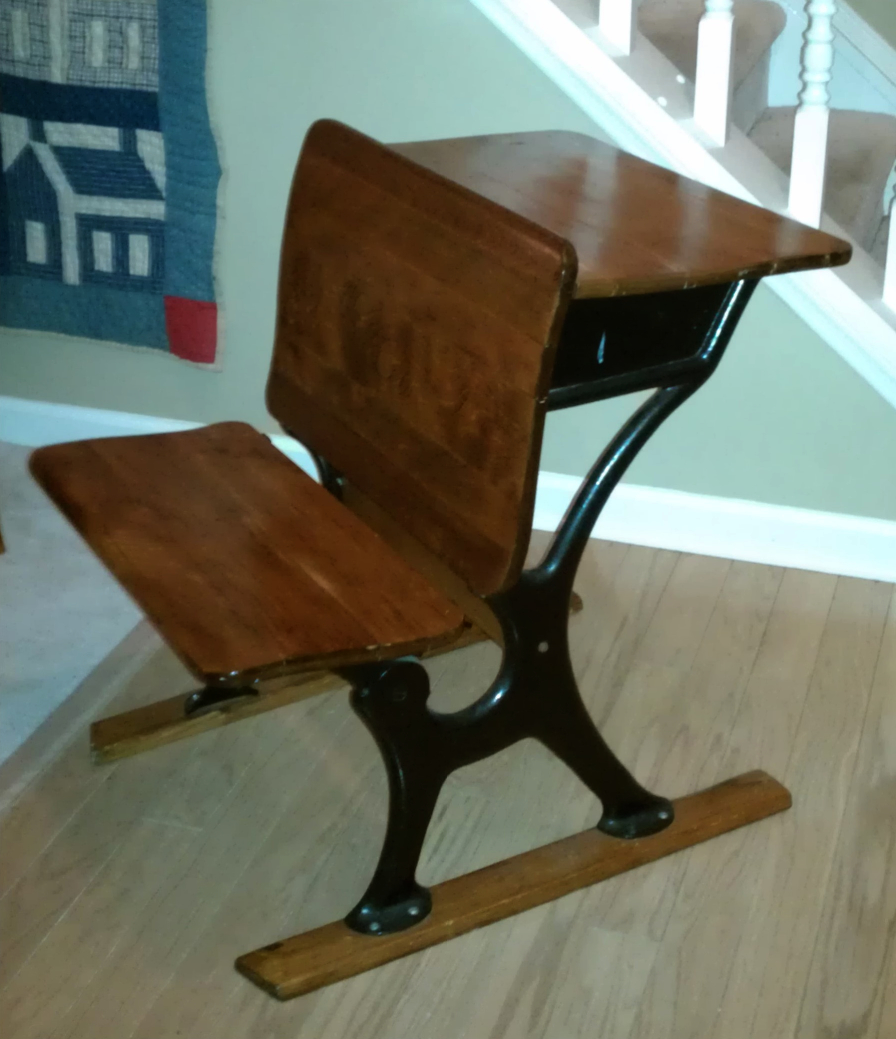
Next up is an antique school desk.  This one is in exceptionally good condition – only one piece of gum stuck to the bottom!  This particular model (Model 101) was manufactured by the American Seating Co. in the early 1900’s.   There is an fascinating history of theater, school, and bus seating on the American Seating Co. website.   The frame is made of steel and the seat flips up for easy storage.  This may go in the entranceway – the perfect place to sit while you put on or take off shoes.

Antique Schoolhouse Desk

There is a store in downtown Apex called The Rusty Bucket owned by Pam and Mack Thorpe.  They carry all types of antique and primitive items and I go there all the time to see what “new” things they have.  I was lucky enough to be in town last week when they hosted “The Gathering”, a huge sale that featured all the wonderful antiques that Pam and Mack found when they went “pickin'” in some old barns.

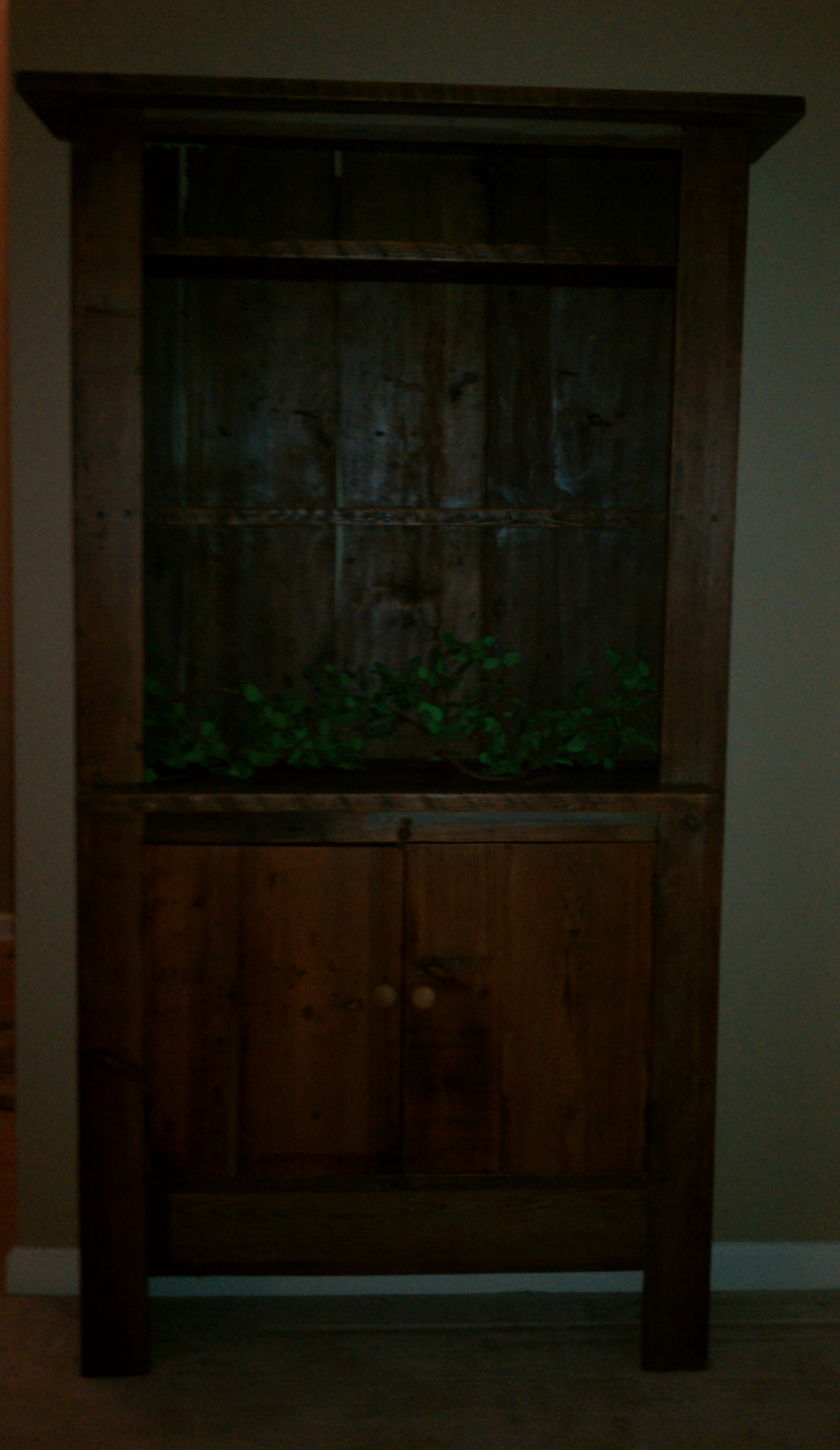
Barnwood Cupboard

The biggest thing I bought was a wooden cupboard made out of old barnwood.  I needed something like this for the house to add some height to my living room.  I’m not sure how old this is, but it definitely has some authentic distressing and works great with the other primitive things in the house.  This thing is very heavy and so once I find a place for it – it won’t move!
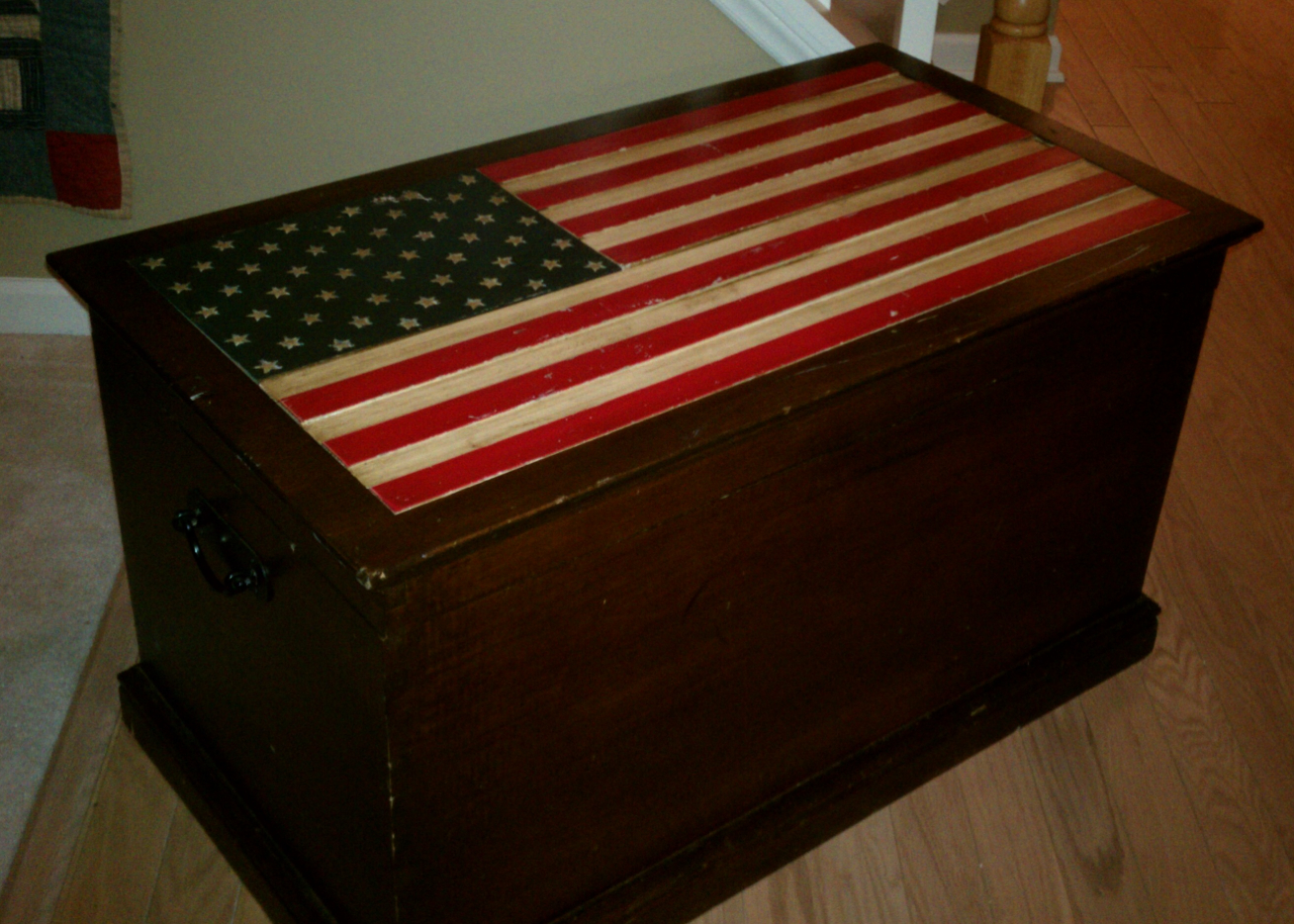
Vintage Flag Trunk

The last thing is my most favorite find (sorry Barbara, you can’t have it!).  It’s a vintage trunk with an American Flag carved into the top.  There are 50 stars on the flag, so I assume it was made in the 1960’s.  It is made of a nice heavy dark wood, and there is a tray inside that lifts out.  Not sure where this is going yet, but I am sure my decorator (Liberty Rose)  can help me figure it out!
In other news, I have a few sewing things I am working. I will also be posting a tutorial next week for a fun Valentine’s project.

Keep it Thimble!